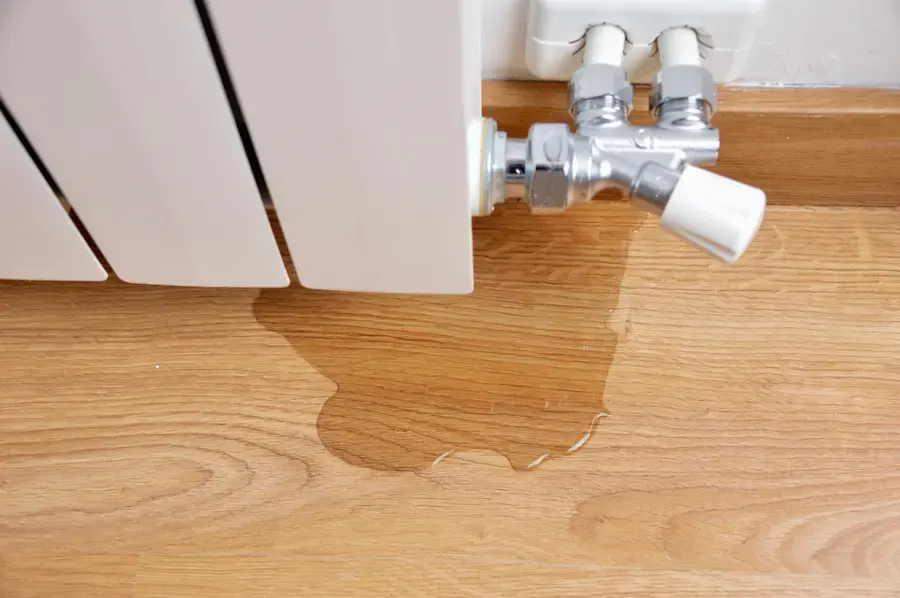
Many East Elmhurst homes are attached and semi-detached brick row houses and two-family homes, built mostly from the 1920s through the 1950s. Heating in houses like these often means a boiler and radiators, and a leak in that system behaves differently from a leak in a supply pipe.
Key takeaways
- A heating leak is usually slow and steady, so damage builds in floors and ceilings before anyone sees a puddle.
- The water in a heating system is not drinking water. Treat wet materials with care and have them checked.
- Shut off the boiler and its water feed first, if that is safe, then find where the water is going.
- Leaks travel along pipes, down through floor boards and into the ceiling of the room or unit below.
- Drying covers the floor, the cavity beneath it and the ceiling below. A wall or ceiling is opened only where readings say the moisture is.
Why heating leaks differ from supply leaks
A supply pipe carries water under pressure, and when it fails the water comes fast. A heating pipe or radiator valve usually weeps.
A weeping leak can run for weeks before a stain shows. By then the floor beneath the radiator may be soaked, and the ceiling below may be wet.
- Supply leaks tend to be sudden and obvious.
- Heating leaks tend to be slow and hidden, often near a valve or a joint.
- A boiler that needs frequent water added may be losing it somewhere in the house.
Where the leak shows up in a row house
In a brick row house, heating pipes run along floors, up through walls and under stairs. Radiators sit on the floor against exterior walls, often over finished wood.
Water follows gravity and the pipe. It can run along a joist before it drops.
At the radiator or valve
The valve stem or the union at the base of a radiator is the common weeping point. Look for rust, a dark ring on the floor or a damp patch on the wood.
Along the pipe run
A pinhole in a pipe inside a floor or wall may only show as a spreading stain. The stain is often far from the actual leak.
At the boiler
A boiler leak shows up in the basement or utility room, and water may run toward the nearest drain. In a two-family home it can reach a basement apartment.
The first steps
The goal is to stop the loss and protect what is below. A heating system is hot, so the safe steps are limited.
- Turn off the boiler at its switch and let the system cool before touching any valve.
- Close the boiler's water feed valve if it is easy to reach and safe.
- Do not open a hot radiator valve or bleed it to look for the leak.
- Place a pan or towels under the weeping point and move belongings off the floor.
- Photograph the leak, the stain and the floor and ceiling around it.
- Call a plumber or heating contractor for the repair itself.
What the water does to a floor and ceiling
Heating water runs warm, and warmth speeds the way a slow leak soaks a floor. Hardwood can cup, plaster can sag and the framing underneath can stay wet for a long time.
A ceiling that has taken a slow leak may look fine and still hold water above the plaster. Press a finger to a stain only with care, because a bulge can drop all at once.
- Floors cup, buckle or darken near the leak.
- Plaster and drywall bulge, stain or crack.
- Paint blisters on the ceiling below.
- Insulation in the cavity holds water and keeps the framing wet.
What drying covers
Drying starts once the source is fixed or isolated. A leak that is still running only restarts the damage.
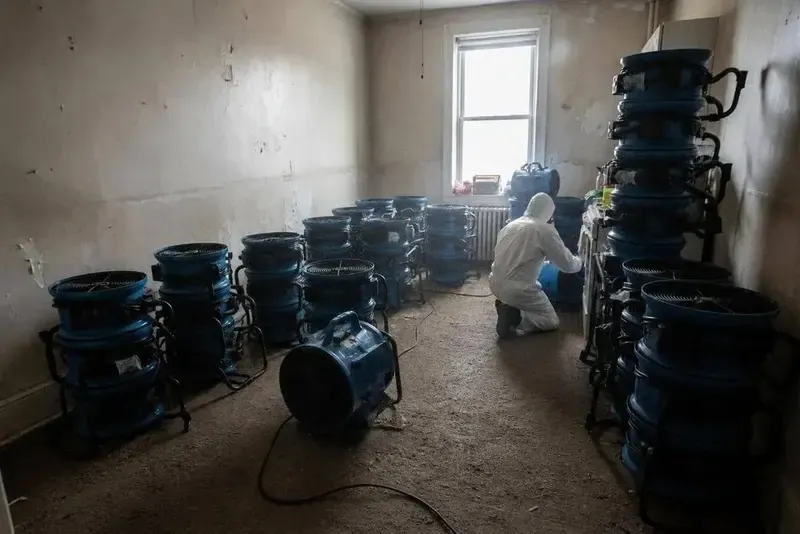
The crew maps moisture with meters rather than guessing, then dries each wet layer.
The floor and subfloor
Wet flooring is checked and, where it cannot be dried, removed. The subfloor and joists are dried in place with controlled airflow and dehumidification.
The ceiling and cavity below
A wet ceiling is opened safely so trapped water can drain, then dried with the cavity above it. Only the affected section is opened.
See structural drying for how the equipment and readings work.
Two-family homes and the unit below
Many East Elmhurst houses are two-family homes, with a unit or a basement apartment below the main floors. A heating leak upstairs often turns up as a ceiling stain below.
That is why a ceiling leak call so often turns out to be a heating pipe. Tracing the source matters before anyone repaints.
- Tell the other household as soon as a leak is found.
- Ask for access to the ceiling below, even if it looks dry.
- Keep photographs of both floors for the insurance file.
Keeping the next leak small
Heating systems in older row houses give warning signs before they fail. A few habits catch a weeping joint while it is still small.
None of this replaces a heating contractor, but it helps a leak get found early.
- Look at radiator valves and unions for rust, drips or a dark ring on the floor.
- Watch the boiler's water level and note how often it needs topping up.
- Check the ceiling below a radiator for new stains after the heat comes on.
- Have a heating contractor look at an old valve before the cold season, not in the middle of it.
When to call for a crew
A damp patch near a radiator can be mopped and watched. A wet floor, a stained or sagging ceiling or a boiler that keeps losing water is time for professional drying.
The restoration team handles the water damage, and a heating contractor fixes the system. See boiler and radiator leak water damage for how that process runs.
Questions
Is a boiler leak the same as a burst pipe?
No. A burst pipe floods fast. A boiler or radiator leak is usually slow, so damage often hides in floors and ceilings for a long time before it shows.
Is water from a heating system dirty?
It is not drinking water and can carry rust and sediment. Wet materials are handled with care, and a crew can tell whether they can be dried or have to be removed.
Can I keep using the heat?
Not while it is leaking. Turn the boiler off, and have a heating contractor repair the leak before the system runs again.
Why is the stain below not where the radiator is?
Water travels along pipes and joists before it drops. The stain shows where the water found a way through, not necessarily where the leak began.
Will insurance cover a heating leak?
It depends on the policy and on whether the leak was sudden or long term. Photograph everything, keep receipts and ask the insurer before repairs begin.