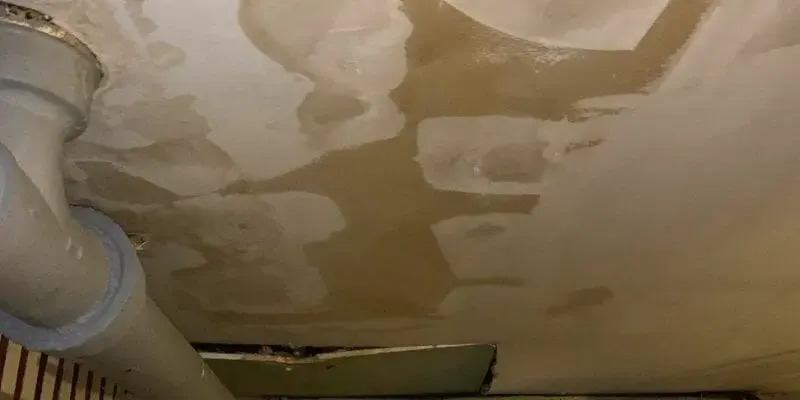
In a stacked building, water seldom stays where it starts. A leak in the unit above can show up as a stain on a plaster ceiling, a bubble in the paint or a damp patch on parquet, and in a Jackson Heights co-op it also raises the question of who is responsible.
Key takeaways
- Water moves down and sideways through shared walls, so a leak in one apartment often damages two or three others.
- Call the building super or managing agent right away, because the shutoff for the leaking unit or riser may be theirs to control.
- More than 200 original Queensboro Corporation apartment buildings still stand in Jackson Heights, and many are cooperatives with a board.
- Sagging plaster can fall, so keep out from under a bulging ceiling.
- Drying matters as much as repair, since wet plaster, lath and framing hold water long after the leak is fixed.
How Jackson Heights buildings are built
Much of Jackson Heights was built in the 1910s through the 1940s. The Queensboro Corporation laid out the planned community in 1916 and built garden apartments around shared private gardens.
More than 200 of the original buildings still exist, and the Jackson Heights Historic District, designated in 1993, covers almost 600 buildings. Many of those buildings are cooperatives.
- Early garden apartments had parquet floors, fireplaces and built-in bathtubs with showers.
- Modest buildings were walk-ups of no more than five floors, since elevators needed attendants until 1922.
- Prewar buildings commonly still have original galvanized steel supply pipes and cast iron waste stacks, a regional pattern rather than a rule for every building.
How water travels between units
In a stacked layout, a leak above can follow the pipe chase, run along a joist or soak through plaster to the apartment below. The ceiling often shows the damage before the source is found.
A leak can start with a washer hose, a bathtub overflow, a cracked supply pipe or a failed seal around a fixture.
Where the stain appears
The stain is not always directly under the leak. Water can travel along framing and appear several feet from where it entered.
What the ceiling is telling you
- A brown ring that grows means the leak is still active.
- A bulge in the plaster means water is pooling behind it.
- A musty, wet smell means the cavity is holding moisture.
Who to call first
In a co-op, the order of calls matters. The building super or managing agent can often reach a shutoff for the apartment above or for the riser.
The board or the managing agent also decides who handles the repair and the cost under the building's rules. A unit owner should read the proprietary lease and the building's house rules for that.
- Call the super or the managing agent with the unit and the location of the stain.
- Ask for water to be shut off to the source, if the source is known.
- Notify the owner of the unit above, if the building does not.
- Photograph the damage and the date.
- Tell the insurer, since a co-op owner often has an individual policy for interior damage.
Keeping people safe under a wet ceiling
A wet plaster ceiling can fall without warning. The weight of trapped water adds up quickly.
- Stay out from under a bulging or sagging ceiling.
- Move furniture and valuables away from the wet area.
- Place a bucket under any drip, and keep the area clear.
- Turn off any light fixture that is wet or flickering.
- Do not poke a bulge unless a professional is on site and prepared for the water.
What drying covers in a prewar apartment
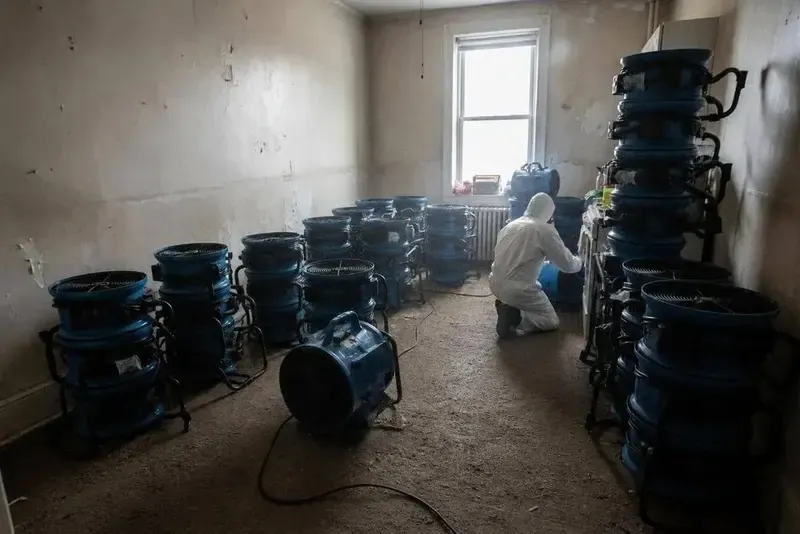
Fixing the leak stops the flow, but the wet materials stay wet. Plaster, lath, framing and parquet all hold moisture and release it slowly.
The restoration team measures moisture, opens the ceiling only where readings say, and sets drying equipment. Parquet is dried carefully, because quick heat can make wood cup or crack.
What gets measured
- Moisture in the plaster and in the framing above it.
- Moisture in the parquet and the subfloor.
- Moisture in the walls next to the leak.
What the equipment does
Air movers push dry air across wet surfaces, and dehumidifiers remove moisture from the air. Drying continues until readings fall close to a dry reference.
Two apartments, one claim
In a co-op, a single leak can involve the unit above, the unit below and the building. Each may have its own insurance.
Records that show the source, the dates and the readings help each party. The restoration team documents the damage in each unit it dries.
- Keep a copy of the report to the super or managing agent.
- Ask for moisture readings in writing.
- Save receipts for temporary housing or storage if needed.
What a resident can do before the board answers
Buildings take time to respond, and water does not wait. A resident can limit damage while the board or the super sorts out the source.
These steps fit most stacked buildings.
- Move furniture, rugs and electronics out from under the stain.
- Put a bucket under any drip and a sheet of plastic over what cannot move.
- Photograph the ceiling, the floor and the date, and photograph again as the stain grows.
- Message the super and the managing agent in writing, so there is a record of when the leak was reported.
Why parquet and plaster need patience
Early garden apartments had parquet floors, and the plaster ceilings in older buildings are thick and heavy. Both react slowly to water.
A floor can look flat on day one and cup a week later, and a ceiling can hold water well after the drip has stopped. That is why readings matter more than appearances.
The restoration team checks both surfaces with meters, so repair decisions rest on numbers and not on how the surface looks.
Where to find more
See ceiling leak water damage in Jackson Heights and structural drying in Jackson Heights for the process.
The Jackson Heights town page has the neighborhood overview, and the main page on ceiling leak water damage covers the general steps.
Questions
Who pays when the unit above leaks into my apartment?
It depends on the cause, the building's rules and the insurance policies. Document the damage and tell the managing agent, the owner above and your insurer.
Is a sagging plaster ceiling dangerous?
Yes. Wet plaster can fall. Stay out from under it and ask a professional to open it safely.
Can parquet floors be saved after a leak?
Often, if they are dried promptly and carefully. Moisture readings show whether the wood is returning to a normal range.
How do I know the leak is stopped?
When the source is shut off and readings stop rising. A growing stain means water is still moving.
Should the board be told about a small leak?
Yes. A small leak can come from a pipe that serves several apartments, and the board or managing agent needs to know.