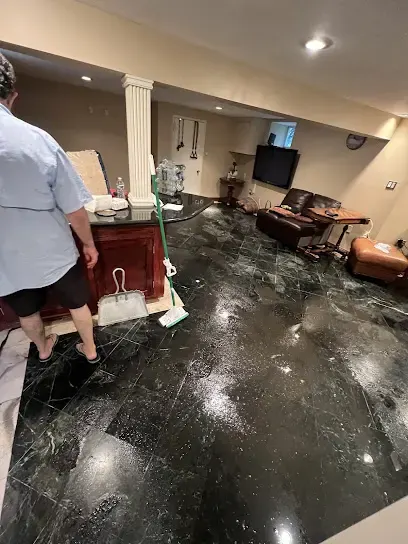
College Point sits on low ground between Flushing Bay and the East River, and for a long stretch of its history it was a peninsula cut off by Mill Creek. Water that reaches a basement here often arrives from the street, the yard or the ground itself, not from a broken pipe inside the house.
Key takeaways
- Water that enters a basement from outside is treated as contaminated, because it crosses the street, the yard and the foundation first.
- College Point has a long flooding history tied to Mill Creek, the Flushing Airport wetlands and Linden Place. A 2024 drainage project does not mean flooding is over.
- Find where the water entered before anything is moved. A wall, a window well and a floor drain call for different cleanup.
- Standing water comes out first with extraction equipment. Wet walls and floors are dried only after the water is gone.
- Photograph the water line, keep receipts, and ask a plumber about the sewer pipe on the property once the basement is dry.
A peninsula built on creek and wetland
College Point was a peninsula separated from the rest of Queens by the partly infilled Mill Creek until the middle of the 20th century. Flushing Bay lies to the west and the East River to the north.
That history still shapes the ground. Low land near tidal water holds moisture, and heavy rain has few places to go.
- Flushing Airport opened in College Point in 1927 and had runway flooding before it was decommissioned in 1984.
- Linden Place was closed for years because of frequent flooding near the old airport, which was built on a wetland atop Mill Creek.
- Linden Place was later renovated to sit several feet above the wetlands, and the first portion reopened in 2015.
How outside water gets into a basement
Most College Point residences are single-family houses, and many date from the 1920s. A basement in an older house has several ways to take in water when the street or yard is saturated.
Each entry point leaves a different pattern, and the pattern tells the crew where to look.
Through the walls and floor
When the ground around a foundation fills with water, it can seep through cracks, joints and the seam where the wall meets the slab. The water shows up first at the base of the wall.
The floor can feel damp or darken before any puddle forms.
Through windows, doors and stairwells
Runoff pooling against the house can pour through a basement window well or down an exterior stairwell. This water often carries soil and debris with it.
A line of mud on the floor is a common sign.
Up through drains and toilets
When storm sewers fill, water can push back up through a floor drain. That water is sewage-contaminated and is handled as a sewer backup, not as a simple flood.
What the 2024 drainage project changed, and what it did not
DEP and other city agencies completed a $139 million drainage and water main project in College Point, announced on September 26, 2024. It covered over 100 blocks.
The project separated what was a combined sewer system, tripled the neighborhood's drainage capacity and significantly reduced overflows into Flushing Bay. It added seven large storm sewer chambers, 300 new catch basins and a tide gate that keeps tidal water out of the storm sewers at high tide.
That is real progress. It does not promise that no basement will take water again, and a house with a weak foundation, a low window well or a failing property pipe can still flood.
- DEP says the city sewer system typically handles about 1.75 inches of rain an hour.
- Hurricane Ida remnants set a New York City record of 3.15 inches in one hour on September 1, 2021.
- A storm that outruns the system can leave water in any low basement, whatever the pipes were built to carry.
The first steps in a flooded basement
Outside water is not clean water. Treat the room as contaminated until a crew has checked it.
The first steps are short and about safety.
- Stay out of the water if it is near outlets, the electrical panel or a plugged-in appliance.
- Keep children, pets and anyone with an open cut out of the room.
- Photograph the water line on the walls and the damaged belongings before anything moves.
- Note where the water entered, such as the floor drain, a window or the base of a wall.
- Do not use a household wet vacuum on large amounts of water that came from outside.
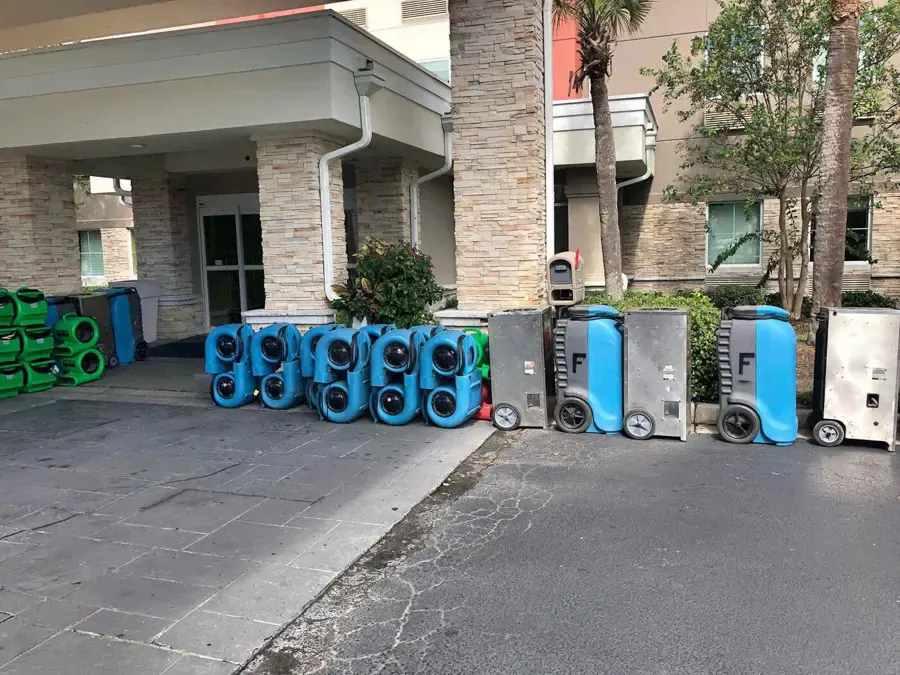
What extraction and drying cover
Standing water comes out first. Truck-mounted and portable extraction equipment removes it from the floor, and the crew checks how far it traveled into wall bases and stored items.
Drying only starts once the water is gone. Moisture readings show where the structure is still wet, and the crew opens a wall only where those readings point.
Materials that usually come out
- Carpet and pad that sat in the water.
- Drywall and insulation that wicked water upward.
- Cardboard boxes, particleboard furniture and upholstery.
Surfaces that can often be saved
Concrete floors, brick and sealed hard surfaces are cleaned, treated and dried. Structural drying then brings the framing and masonry down to a normal moisture level.
Sump pumps, owners and the sewer pipe
On low ground near Flushing Bay, DEP's general advice applies: use a sump pump with discharge pipes that carry water well away from the building. A pump that dumps water beside the foundation only sends it back around.
DEP says the property owner owns and must maintain the sewer service pipe from the building to the city sewer main in the street. DEP inspects a reported sewer backup within six hours of the 311 complaint.
- Report a backup to 311 so there is a record and an inspection request.
- Claims against the City go to the NYC Comptroller within 90 days.
- The law does not require backflow prevention devices for most NYC homes, but DEP says they can help.
When to bring in a restoration crew
Any water that covers more than a small patch of floor, reaches carpet or drywall, or came through a drain is a job for trained crews. They document readings for the insurance file as they work.
For the full process, see water extraction and storm and flash flood cleanup. The College Point service page lists the rest, and the main storm and flash flood cleanup page covers the wider Queens area.
Questions
Is water from the street or yard safe to clean up myself?
Not in any quantity. Water that crossed the street and yard is treated as contaminated. A small damp patch on concrete can be handled with gloves and boots, but anything that reaches carpet or drywall calls for professional cleanup.
Did the 2024 project stop College Point basements from flooding?
It added drainage capacity and separated the old combined sewer, but nobody can promise flooding is solved. A heavy storm can still overwhelm drains, and a basement can also take water through its own walls or pipes.
Who maintains the sewer pipe that serves a house?
DEP says the property owner owns and must maintain the sewer service pipe from the building to the sewer main in the street. A plumber can check that stretch once the basement is dry.
How long before a wet basement is dry?
Extraction comes first, then removal of soaked materials and structural drying. The time depends on how far the water spread, so ask the restoration team for a drying plan based on the readings.
Should I report a backup even if the water has gone down?
Yes. A 311 report creates a record, asks DEP to inspect and starts the clock on any claim to the NYC Comptroller.